Tag Archives: Educational Psychology

Touching the Earth (Part 4): Interoception and the Wisdom of Equality

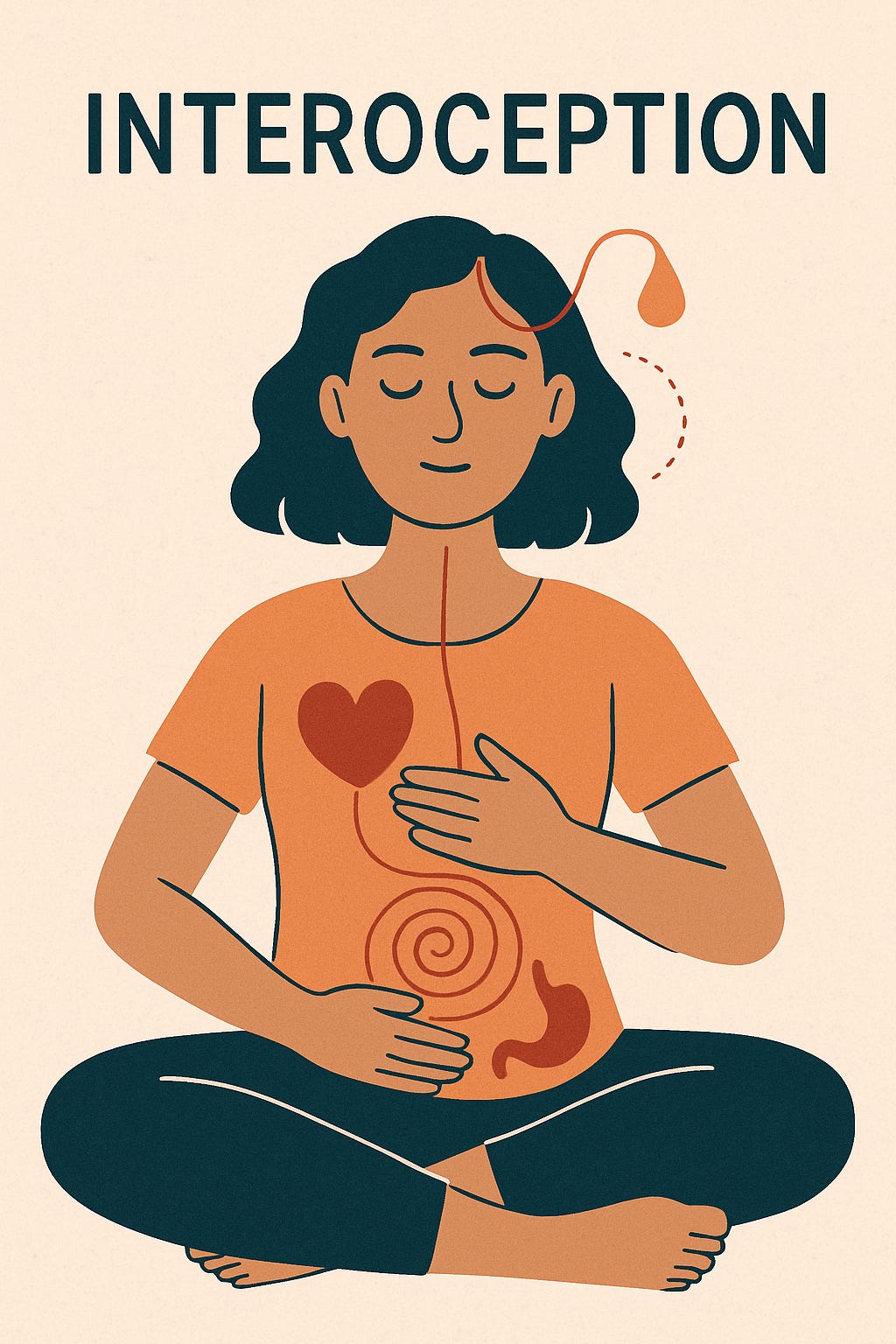
Interoception is the sense of feeling, knowing and responding to what is happening INSIDE our bodies – the capacity to consciously be ‘touching the earth’ of our embodiment.

The experience of embodiment can occur at a range of levels – at times we may hardly notice we have a body at all, and feel ‘caught up in our heads’, ‘lost in thought’ or even ‘dissociated’.

Interoception is an internal sensory system in which the physical and emotional states of the person are consciously or unconsciously noticed, recognised and responded to”. Without this, we can’t tell what we physically or emotionally need – and with unmet needs, we can become dysregulated, overwhelmed and distressed.

A deep and clear experience of embodiment brings with it a capacity for equanimity and peace. My directing out attention to our body sensations repeatedly, we can grow our awareness of what we are feeling and sensing inside. With this capacity we can be better able to empathise with ourselves and others.

For example, we hear some information about the suffering of animals and we may block out or be unaware of the empathetic responses that we have – such responses are not in our conscious control, as they are a result of having a mammalian body.

Our feelings and responses need to be acknowledged. Even the uncomfortable ones! Sometimes uncomfortable feelings are ones that are revealing us some truth that needs to be known.

For example, it is uncomfortable to know about the violence and abuse that happens to animals as a result of industrialised farming practices. Perhaps it is unusual to take time to consider the suffering of other animals, if they are not considered ones that ‘matter’ . If we realise that all beings matter – then the suffering of any being feels ‘wrong’ at a deep and fundamental level.

Buddhist Image of the Bodhisattva Mamaki – the ‘mine-maker’ – who enables us to transcend the poison of ‘self-conceit’ and have insight beyond the limitations of ‘mine’ versus ‘not-mine’. Mamaki with Ratnasambhava enables a liberated perspective of interconnectedness with all beings, human, more-than human etc

Which beings matter has an impact on how we feel about them, and consequently how we treat them.

In Buddhism this is the quality of shared resonance – the Wisdom of Equality from Ratnasambhava and Mamaki, the Bodhisattvas connected to the Earth element. They supports us in transforming the ‘poison’ of self-conceit, pride – the challenge of being born in the human plane.

All beings – human, more-than-human and visible or invisible to humans – all share underlying interconnectedness. The gift of the Bodhisattva of the Earth Element is to be awakened into this ‘equality’.

What may arise, is insight into our resonating empathy with all beings, a profound and far-reaching awakening into our interconnectedness, beyond the boundaries of the illusion of ‘us’ or ‘me’ and ‘them’.

To feel – and have insight into – what it is to resonate with all beings, will require interoception – the ability to sense what is happening inside our bodies. Knowing that we are connected with all other beings – the direct experience of this wisdom – is an embodied experieince.

One practice that can support us in connecting with this resonance and empathy with all beings and help us in acting with wisdom and compassion is the Metta Bhavana, the cultivation of loving kindness. It is based on the Kariniya Metta Sutta – and here is one translation:

Whatever living beings there may be, (moving, strong) animals or (still, weak) plant, without exception, whether they are very long or large or middling in size, or short, great or small, whether they are visible or unseen, whether living nearby or far away, whether they are born, or not yet come to be: may all living beings have happiness.

May we all be well, may we all be happy and make progress in becoming free from habits, misconceptions and addictions that cause us and other being suffering.

With love, light, blessings,

Guhyasakhi

Day Workshop on Mindfulness for Educational and Child Psychologists and those working in schools: an update

Work with children includes using drawings to help them to express their experiences of mindfulness.  Here a child drew how he felt relaxed and comfortable all over his body.

Work with children includes using drawings to help them to express their experiences of mindfulness. Here a child drew how he felt relaxed and comfortable all over his body.

Educational and Child Psychologists have an essential role in schools and work with school staff, families, children and young people.  They apply psychology in a range of educational contexts to help children and young people make progress with learning.

Difficulties with learning may be due to factors that cannot be changed, such as autism or medical needs.  However, they may be also due to factors can be changed – such as the ability to pay attention and regulate emotions. Substantial research evidence shows that mindfulness, a form of training in body-mind integration, can help improve attention, learning potential, working memory capacity and mental health and wellbeing.  Those working in schools can help children and young people become  better able to manage difficult feelings, such as anger, anxiety and low mood.

This workshop is an opportunity for educational and child psychologists and others working in schools to learn about mindfulness and how it can be used as an intervention in schools.  It provides a theoretical and practical overview of mindfulness, including the research evidence for its benefits.  It gives an insight into how mindfulness training may be adapted for those with Special Educational Needs and Disability (SEND) and includes information on the Mindfulness-based Awareness Training (MBAT) intervention that was developed through doctoral research. Though training and support on how to integrate mindfulness into their lives, children and young people can enhance their potential to pay attention and learn.

To learn more about this and to attend a workshop, click here or contact me by email.

Best wishes, Bernadette

What participants have said about the MBSR course

The MBSR course takes place with a small group of people - about 10 to 14 participants.

The MBSR course takes place with a small group of people – about 10 to 14 participants.

I really appreciate getting feedback from participants.  It helps me develop as a mindfulness teacher, appreciating where things work and tweaking bits where need be too.  It helps me ensure that what you are getting what you wanted from the course and that the teaching is adapted to your needs.

You may view the feedback on the the MBSR webpage where there is more information about the course.  I also include it here:

What have participants said about the course?

“I really enjoyed the fact that we were quite a small group. I know other people who have completed the course in much larger groups and I was pleased to find out ours was smaller. I valued most the discussions, reflections and sharing of ideas / experiences and this was enabled through your facilitation and also supported by being part of a small group. I feel I have benefitted both personally and professionally from attending the course.” (Educational Psychologist).

“I appreciated the structured well organised weekly sessions and practise of the mindful techniques to help manage stress and be more relaxed.I particularly liked the simple 3 Minute Breathing Space, which has been my ongoing regular practice that has helped me cope better in some ways.
I am more aware of being vigilant to my thoughts, feelings and actions with the aim to choose how to respond, rather than to simply react to everything. The excellent course handouts were in context with each practical session, that gave meaningful explanation and purpose for benefitting from the MBCT practice.”
(Yoga Teacher)

“I enjoyed the course and have continued to put it into practice within my daily routine. I enjoyed listening to other people’s opinions, challenges and strategies… I would recommend this course for anyone trying to open up their awareness of mindful meditation. I have found that I am less reactive to situations and more aware of my actions as a result.” (Speech and Language Therapist).

“I would recommend [the course] to anyone, particularly within the educational field or within parenting work, where I think it has great applications. I would also recommend that they make the time for as much home practice as possible.” (Educational Psychologist).

“Strongly recommend the course. I have always been resistant to idea of group work/ sharing but a convert. Thank you for enlightening me! I liked way you supported people and kept reiterating effectively that no right or wrong way in meditation and acceptance of what was importance as it seemed to me that some attendees were very hard on themselves and this present as a barrier to them.” (Student Occupational Therapist).

I hope that this feedback may be inspiring to those considering mindfulness training.

Warm wishes, Bernadette

CARE for Teachers: 7th Annual Retreat, Garrison Institute, NY, August 2014

The Garrison Institute is situated on the banks of the Hudson River, an hour norht of New York City.  It is located in a beautifully renovated former Cupucian Monestery, surrounded by forests and fields.  Its focus is on using contemplative practices to support social and ecological change.

The Garrison Institute is located in a beautifully renovated former Capuchin Monestery, of over 7000 square metres, surrounded by forests and fields.

This summer, from 8 to 13 August, I had the privilege of being at the Garrison Institute, NY, for their 7th Annual retreat on Cultivating Awareness and Resilience in Education (CARE) for Teachers.

The Garrison Institute is a not-for-profit, non-sectarian organization siutated on the banks of the Hudson river, an hour north of New York City.  Its focus is on using contemplative practices to support social and ecological change.

CARE for Teachers is an innovative and well-researched programme that directly enhances teacher well-being and indirectly that of their students.

CARE for Teachers is an innovative and well-researched programme that directly enhances teacher well-being and indirectly that of their students.

CARE for Teachers was developed by a team of researchers and professionals working in education and contemplative practices, including mindfulness-based approaches.  The 5-day retreat included daily meditation and other mindfulness practices and explicit teaching of key prinicipals.  The goals were to develop skills to manage the demands of teaching, enhance the joy of teaching and student-teacher relationships and prevent burn-out.

On some days, the retreat began with an early morning  meditation at a nearby waterfall.  There was the option to swim in the waters too: a refreshing way to begin the day.

On some days, the retreat began with an early morning meditation at a nearby waterfall. There was the option to swim in the waters as a refreshing way to begin the day.

The course included consideration of the resources required to develop emotional awareness.  This included respecting emotions and being able to recognise and label them.  It also involved improving how we regulate emotions and respond to complex and challenging situations.   Overall, greater awareness, presence and compassion were developed for use in complex and demanding work contexts, which for most of us, included classrooms. For more information see the CARE for Teachers website.

Presenting the Mindfulness-based Awareness Training intervention at the Implementation Science Conference

The Handbook of Implementation Science contains essential information for those wishing to implement interventions in educational settings.

The Handbook of Implementation Science contains essential information for those wishing to implement interventions in educational settings.

On 28th July 2014, I gave a presentation on the Mindfulness-based Awareness Training (MBAT) intervention at the Implementation Science Conference, organised by the East London Consortium of Educational Psychologists (ELCEP).  Implementation Science is a relatively new area of scientific, academic and practitioner interest that focuses on exploring and explaining what makes interventions work in real-world contexts.

The conference included inspiring talks and workshops.  One keynote speaker, Barbara Kelly, University of Cambridge, was the co-editor of the “Handbook of Implementation Science”.  She spoke about making use of implementation Science in order to successfully transfer and replicate evidence-based approaches, outlining what an intervention needed in order to be implemented successfully.  The factors for this included focusing on the beliefs and values of those trained to deliver the specific intervention and providing consultation and coaching during the implementation process itself.

Another keynote speaker was Elaine Wilson, also from the University of Cambridge.  She presented two case studies in educational contexts; firstly Initial Teacher Education (ITE) in school-university partnerships and secondly, teacher education reform in Kazakhstan.  She explained that certain factors were important to implementing sustainable change, including adopting a “can do” positive approach and focusing on a few, important ambitious goals.

Download the handout of the presentation on the MBAT intervention given at the Implementation Science Conference 28/7/14

Download the handout of the presentation on the MBAT intervention given at the Implementation Science Conference 28/7/14

One of the workshops was my presentation on the process by which the MBAT intervention had been developed through doctorate research and further refined when implemented in another setting.  The MBAT intervention is a mindfulness training course for children and young people with Special Educational Needs and Disability (SEND).  It aims to empower the participants with skills for self-regulation of emotions, helping them be calmer and better focused. The intervention includes gathering information about the context in which the child or young persons needs to develop their skills and understanding.  This enables the MBAT intervention to be adaptable to the needs of the individual concerned.

The process of developing the MBAT intervention was outlined in the presentation and the handout for this is available here.  Overall, the conference was an inspirational experience, motivating me to learn more about Implementation Science.  Currently the materials for the MBAT intervention are being developed into a practitioner workbook.  If you are interested in this work, please contact Holistic Education.


New! Join the Holistic Education Mailing List

MailinglistThe website has been updated! Now you can join a mailing list to receive updates from Holistic Education on events and information about its activities.  You can also specify your interests, choosing from Mindfulness, Yoga, Holistic Therapies and Educational Psychology Services.  if you’d like to join, please click on the picture or here for the sign up form.  Best wishes, Bernadette

Mindful Teachers, Mindful Classrooms

This morning, I was part of the team supporting an “Introduction to Mindfulness” session by Hackney and City Mind, in collaboration with the Mindfulness in Schools Project and Educational Psychology Services at Hackney Learning Trust.  This was an opportunity for those working in schools to find out about how mindfulness can enhance the flourishing of well-being in professional lives, schools and classrooms.

Over thirty participants joined in mindfulness practices and were introduced to the evidence-base for teaching mindfulness in schools.  It was well-received and many were interested in further training in mindfulness, such as the 8-week Mindfulness-Based Stress Reduction (MBSR) course.  Contact Holistic Education for further information about Mindfulness Training in Schools and the .b programme.

Hackney and City MINDDot B MISPHackney Learning Trust

Mindfulness Interest Group, Hackney Learning Trust

Hackney Learning Trust

There is a monthly Mindfulness Interest Group at the Hackney Learning Trust.

Today I ran the first Mindfulness Interest Group at the Hackney Learning Trust.  It was brilliant to spend my lunch break discussing and sharing a few mindfulness practices with others.  Some had no experience, and others had done an 8-week course.  Overall, they were keen to have more opportunity to learn about mindfulness at work.

The next session is planned for Tuesday 29th April and the plan is to discuss how best to promote mindfulness in the work place.  We will also explore material from the Peace in a Frantic World book.