Category Archives: Uncategorized

New MBSR course in Walthamstow, E17 in September

Holistic Education will be running a Mindfulness-based Stress Reduction (MBSR) course this September.  For more information click here  or contact Holistic Education.  There’ll be a taster session on Monday 22nd September at 6:30pm and the 8-week course will begin the week after, on 29th.  The venue is near Walthamstow Village, about 5 minutes walk from Walthamstow tube station.  If you are interested, click on the link below.  And if you do pass this one to others who may be interested, many thanks in advance.  Warm wishes, Bernadette

Eventbrite - Mindfulness-based Stress Reduction (MBSR) course in Walthamstow

Taraloka and the “Wisdom of the Awakening Heart” retreat (July 2014)

During July this year, I was priviledged to be at the “Wisdom of the Awakening Heart” Retreat at Taraloka.  It was led by Vijayamala and Maitrivajri, two ordained Buddhists from the Triratna Buddhist Community.  I realise that it is beneficial to attend retreats regularly to develop my own practice of mindfulness and meditation.  In the past, I had attended classes by a range of teachers.  I noticed that I found Maitrivajri’s style of teaching meditation to resonate with me and for that reason I chose this particular retreat.

Taraloka is a beautiful retreat centre in Shropshire, run by members of the Triratna Buddhist Community.

Taraloka is a beautiful retreat centre in Shropshire, run by members of the Triratna Buddhist Community.

The retreat ran for seven days and each day involved several hours of meditation, starting at 7am with a 90 minute session before breakfast.  After breakfast there was a talk and another 90 minute session before lunch.  In the afternoon, there was a third practice before supper and a final one before bed time.  So each day, apart for helping out in varioius community related activites (such as helping to make a meal or with tidying up), there was ample opportunity to develop meditation experience.  The retreat was also held in silence, from the second day to the second last day, allowing five days of no speaking (or speaking limited to essential moments) except during the two 10 minute meditation reviews, which for me, were on the third and 5th days of the retreat.  I also enjoyed running each day and doing some yoga, and altogether this helped deepen the experience of being.

The meditation practices and talks were on an aspect of Buddhism called the “Mandala of the Five Prajnas”.  The Prajnas (or ‘wisdoms’) are qualities that are beyond words and which need to be experienced to be understood, as they exist in the awareness we bring to our experiences.  One ‘wisdom’ was in perceiving things as they are, thereby coming into relationship with our experiences in an authentic way.  Another was in awareness of our shared humanity.  The third wisdom was in noticing, accepting and rejoicing in our uniqueness and individuality.  The fourth was in cultivating freedom and spontaneity in awareness.  The fifth was in deepening awareness into something beyond words, the infinite and boundless present.

Overall the retreat was a much appreciated as a opportunity to cultivate insightful and deeper aspects of awareness.  I hope that in reading this, you may feel inspired to explore the Mandala of the Five Prajnas.  For more information, please get in contact.

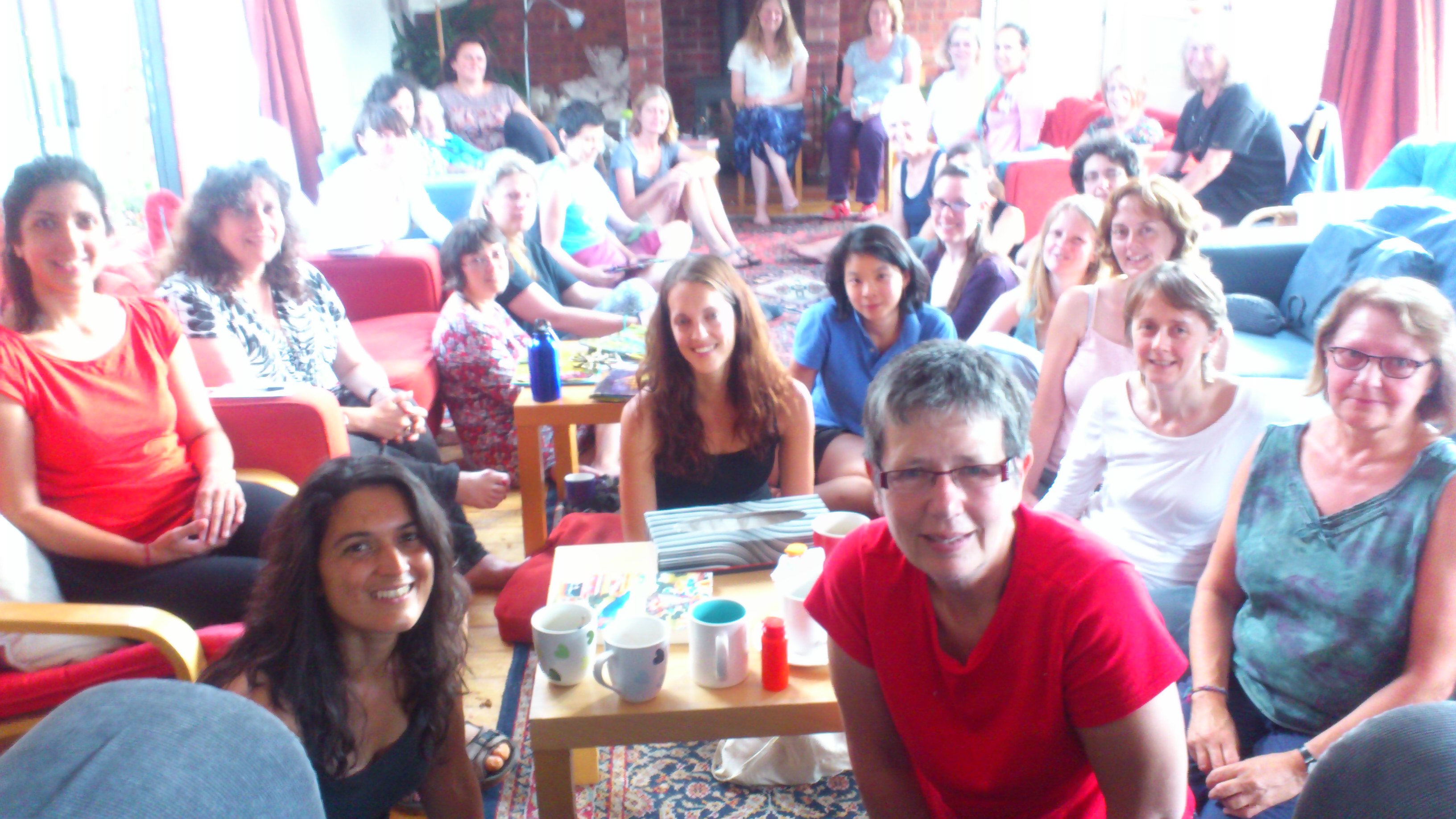
Here I am (Bottom left of picture) at the Wisdom of the Awakening Heart retreat at Taraloka.  It was an inspiring event that helped to further develop and deepen my meditation practice.

Here I am (see bottom left of the picture) with almost all the other participants at the Wisdom of the Awakening Heart retreat at Taraloka. It was an inspiring event that helped to deepen my meditation practice.


Chi Nei Tsang: an increasingly popular therapy provided by Holistic Education

Mantak Chia has been the main teacher in bringing Taoist practices into western awareness and has written dozens of books, including a few on CHi Nei Tsang.

Mantak Chia has been the main teacher in bringing Taoist practices into western awareness and has written dozens of books, including a few on CHi Nei Tsang.

Chi Nei Tsang is an ancient therapy that integrates aspects of Shiatsu, Chi Kung meditations and Tai Chi technique.  It aims to harmonise the flow of energy though working predominantly on the abdomen or hara.  It has become increasingly popular in recent years and the result has been an increase in the number of people requesting this therapy from Holistic Education.

In response to this, I have developed a new webpage, specifically on Chi Nei Tsang and I hope you enjoy finding out more about it and maybe, one day having a treatment for yourself.

In the meantime, I hope you enjoy watching this introductory video, created by Kris Deva North from the London Healing Tao Centre.  I’m in it, doing some treatments and a bit of teaching.  It was filmed in April 2013.  Your feedback is welcome.

Wishing you well-being, health and happiness, Bernadette

Teaching Yoga in Prisons: 4 days of training for yoga teachers by the Prison Phoenix Trust and British Wheel of Yoga

The Prison Phoenix Trust is a charity that encourages prisoners in their spiritual lives through meditation and yoga, working with silence and the breath.

The Prison Phoenix Trust is a charity that encourages prisoners in their spiritual lives through meditation and yoga, working with silence and the breath.

From Monday 23 June to Friday 27 June, I trained to teach yoga in prisons, though a programme taught by the Prison Phoenix trust (PPT) and accredited by the British Wheel of yoga (BWY).  I’ve been teaching yoga since 1998, and qualified as a yoga teacher in 2001.  This intensive training enabled us to learn how to teach yoga, breathing practices and meditation in a way that was accessible to a range of participants and adapted to meet their needs, safely and effectively.
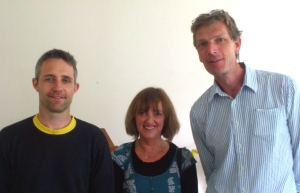
Brent Scott (left) and Sally Buxton (centre) are both Yoga Co-ordinators for the PPT. Sam Settle (right) is the PPT Director. They co-led the training programme.

Since 2001, I have taught yoga and meditation in a range of settings, including private yoga centres, individual homes, adult education settings and schools.  The participants have been from a range of ages, from 7 to 81 years, backgrounds and levels of ability from complete beginner to advanced.  Yet this training prepared me for something different and altogether unique: to teach yoga and meditation in settings where the individuals there had acted in ways that meant not being allowed to participate in general society for a period of time.

The 4 day training programme was wonderfully practical, informative and fun.  There were speakers from prisons, including Prison Officers, ex-inmates and yoga and other teachers working in prisons, youth offending institutions, prison hospitals and other high security settings.  There were talks, meditation and yoga sessions and discussion groups.  We even had a bit of time to fit in a few walks in the beautiful Oxfordshire countryside and have an evening of games, singing and music provided by ourselves.

We not only deepened our personal practice, though morning and evening practice sessions, but also our understanding of the complexities of the lives of those living and working in prisons.  Overall, I gained confidence not only in how to adapt the teaching of yoga and meditation, but also in how to adapt myself to a setting in which security is of paramount importance.  It was a brilliantly run and intense training course and I highly recommend it to any yoga teachers interested in such work.


Sunday meditation with a local group: developing personal practice with others

It takes time and patience to build up a regular mindfulness practice and it helps to bring some light-heartedness to it.

It takes time and patience to build up a regular mindfulness practice and it helps to bring some light-heartedness to it.

Let’s say you have done some mindfulness or mediation training or even a retreat.  Once that has passed, and we’re back in our busy lives, it takes an extra effort of will to ensure that some time is carved out of the day or week to continue practising.  Yet even with the best intentions to practice, this can sometime be so difficult that practice becomes irregular and it can seem that any benefits are no more.

You’re not alone.  Even the most regular and dedicated mindfulness mediator find that from time to time their regular practice gets swept aside by the demands of life.  I’ve found it particularly helpful to practise with others and am fortunate to be part of a small local group of others who meditate.  Today, we gathered at someone’s home for a 45 minute sitting practice, which we agreed helped us reconnect to deeper qualities in our practice.

Perhaps you also meditate regularly with others or would like to do so.  Why not set up a group, perhaps running the Peace in a Frantic World Course?  Or you could contact local teachers in your area or go on a retreat.  This could be key to developing and sustaining the practice of mindfulness, helping us enrich and get the best out of our lives.


Teaching mindfulness at the Hackney Learning Trust: the Mindfulness Interest Group continues

Hackney Learning Trust runs all the education services for the London Borough of Hackney. It is responsible for schools, children’s centres, early years and adult education.

Hackney Learning Trust runs all the education services for the London Borough of Hackney.
It is responsible for schools, children’s centres, early years and adult education.

Last Tuesday I led another session of the Mindfulness Interest Group, which is open to staff from Hackney Council and the Learning Trust.  The group brings together anyone interested in learning about and practising mindfulness.  This was the fourth session since the group began and it included a sitting practice and body scan.  These are both formal mindfulness practices for cultivating a friendly, curious, non-judgemental awareness of our experiences, moment by moment.

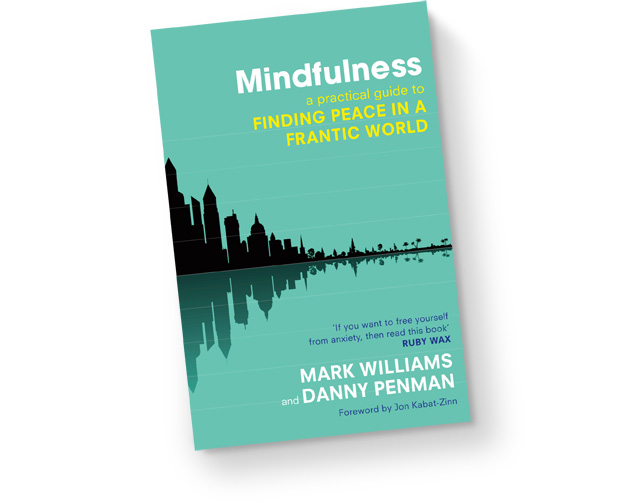
To explore mindfulness practices in the workplace, we draw upon ideas and exercises from the book, Finding Peace in a Frantic World.   There is an intention to develop skills to enhance more positive mental states and increase resilience to stress.

Finding Peace in a Frantic World - a book by Mark Williams and Danny Penman, which is a newly developed 8-week course.

Finding Peace in a Frantic World – a book by Mark Williams and Danny Penman, which is a newly developed 8-week course.

Mindfulness practices involve repeatedly making a conscious shift in our frames of mind, moving from a mode of ‘driven-doing’ to one of ‘mindful-being’.  The group is an opportunity to first-handedly experience this tried and tested, evidence-based practice for reducing patterns of automatic reactivity. There is a sense of empowering ourselves by simply pausing, for a relatively brief moment in time, to consciously guide our awareness with gentleness and kindness upon the transient, raw and ineffable experience of being alive, in all its richness and complexity.  For benefits that this brings, the practice of mindfulness is deeply appreciated.

How can mindfulness be adapted for different populations?

Chris Cullen from the Oxford Mindfulness Centre and Mindfulness in Schools Project.  He presented the workshop for the Exeter Mindfulness Network.

Chris Cullen from the Oxford Mindfulness Centre and Mindfulness in Schools Project. He presented the workshop for the Exeter Mindfulness Network.

On 12 June, Chris Cullen, from the Mindfulness in Schools Project and Oxford Mindfulness Centre gave a workshop by the Exeter Mindfulness Network, University on “Adapting mindfulness for different populations”.

I was inspired.  Here was a clear way to make mindfulness accessible to those with a range of needs, from young people to those in highly stressful work situations, while maintaining the essential integrity of the programme. The key message: follow the structure of the well-researched, tried and tested Mindfulness-based Cognitive Therapy programme.

The workshop was designed for those with training and experience in teaching mindfulness, following the Good Practice guidelines for teaching mindfulness-based courses.  While MBCT was designed for preventing relapse into depression, with care and consideration, it can be made applicable to a much wider audience, including the general population itself, and maintain its essential integrity.

When considering how to adapt MBCT, the first step is to bring to mind are the core intentions of the programme itself and to ensure that the teaching is orientated towards these throughout.  Then, bearing in mind the particular needs of the target group, the theoretical and practical reasons for making the changes are considered. Essentially, the training aims to empower the participants with mindfulness-based skills to better manage “crux” moments in their lives.  These are times when mindfulness skills are drawn upon to respond rather than react, to make ‘wise’ choices, rather get drawn into automatic, habitual patterns of thinking, feeling and behaving.

Finding Peace in a Frantic World - a book by Mark Williams and Danny Penman, which is a newly developed 8-week course.

Finding Peace in a Frantic World – a book by Mark Williams and Danny Penman, which is a newly developed 8-week course.

These steps are key to the process of developing a well-structured mindfulness programme for a range of populations and needs, and it has been tried and tested in the development of the  “.b” (dot-b) programme for teens by the Mindfulness in Schools Project and the Peace in a Frantic World course for in the general population wanting to enhance resilience to stress and promote well-being.

The workshop was run by the Exeter Mindfulness Network and held at the University of Exeter.

The workshop was run by the Exeter Mindfulness Network and held at the University of Exeter.

New! Join the Holistic Education Mailing List

MailinglistThe website has been updated! Now you can join a mailing list to receive updates from Holistic Education on events and information about its activities.  You can also specify your interests, choosing from Mindfulness, Yoga, Holistic Therapies and Educational Psychology Services.  if you’d like to join, please click on the picture or here for the sign up form.  Best wishes, Bernadette

Mindfulness Interest Group meets again at the Hackney Learning Trust

Hackney Learning Trust runs all the education services for the London Borough of Hackney. It is responsible for schools, children’s centres, early years and adult education.

Hackney Learning Trust runs all the education services for the London Borough of Hackney.
It is responsible for schools, children’s centres, early years and adult education.

Last week, on 20th May, I held the third session of the Mindfulness Interest Group.  It was heartening to see over twenty people, from Hackney Council and the Learning Trust, giving up their lunch break to learn about and practice mindfulness together.

I gave a short presentation on Mindfulness and Finding Peace in a Frantic World and we did the Raisin Exercise and a sitting mindfulness practice.

Overall, feedback was positive and I look forward to the next session on 17th June 2014.  For more information about this, or if you’d like an introductory workshop on Mindfulness at your workplace, please contact me. Best wishes, Bernadette

Practice mindfulness with the Mindfulness Interest Group at the Hackney Learning Trust

Hackney Learning Trust runs all the education services for the London Borough of Hackney. It is responsible for schools, children’s centres, early years and adult education.

Hackney Learning Trust runs all the education services for the London Borough of Hackney.
It is responsible for schools, children’s centres, early years and adult education.

On Thursday, 1st May, was the second meet-up of the Mindfulness Interest Group.  It is a supportive and friendly group for those interested in mindfulness who are working for Hackney Council.  The aim of the group is to meet up monthly, at the Hackney Learning Trust, to share about mindfulness-related events and projects in the borough and to do some mindfulness practice together.

Most of the group are completely new to practising mindfulness.. and the advantage is that this encourages coming to mindfulness with a “beginner’s mind”, a combination of openness, curiosity and healthy scepticism.  To learn mindfulness, effort is needed.  Although the practice itself is simple, it takes effort and self-encouragement to persevere with it.  The Mindfulness Interest Group provides an opportunity to take a “breathing space” and practice tools needed to enhance well-being and resilience and reduce the effects of stress in the workplace.