
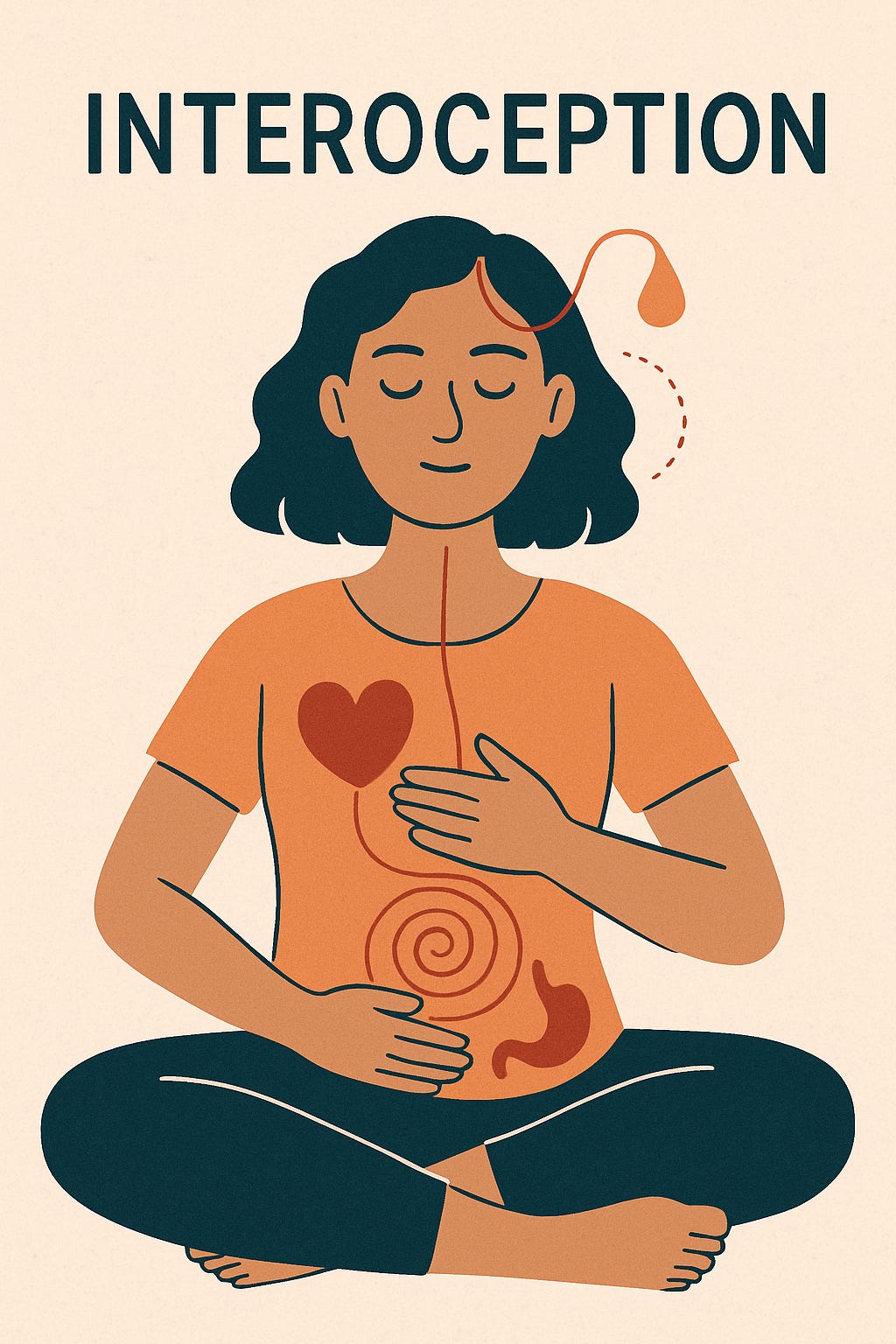
Interoception is the sense of feeling, knowing and responding to what is happening INSIDE our bodies – the capacity to consciously be ‘touching the earth’ of our embodiment.
The experience of embodiment can occur at a range of levels – at times we may hardly notice we have a body at all, and feel ‘caught up in our heads’, ‘lost in thought’ or even ‘dissociated’.
Interoception is an internal sensory system in which the physical and emotional states of the person are consciously or unconsciously noticed, recognised and responded to”. Without this, we can’t tell what we physically or emotionally need – and with unmet needs, we can become dysregulated, overwhelmed and distressed.
A deep and clear experience of embodiment brings with it the capacity for profound equanimity, states of peace and awareness of ones self and others. To experience this more and more fully, meditation supports us in developing one of the senses, interoception. We are taught that we have five basic senses: sight, hearing, touch, taste and smell. However there are many many more.

For example, we hear some information about the suffering of animals and we may block out or be unaware of the empathetic responses that we have – such responses are not in our conscious control, as they are a result of having a mammalian body.
Nevertheless, social conditioning to suppress these feelings and responses can eventually lead to these feelings being so far the background that we are unconscious of them.
And yet these feelings and responses DO exist in our bodies. Without acknowledging this, there might be ‘cognitive dissonance’ – discomfort and disturbance in the body that we may sense in our stomach, shoulders or other part of our body, and even some numbing out from overwhelm. It is likely that this arises when our immediate physical response is at odds with how we think we should be feeling – or feel ‘allowed’ to feel – and in turn this causes dysregulation.
Think about this. Have you ever spoken to someone about a socially unusual topic – or even one that the is different to what the general media is portraying about a situation?
As you talk, you may be aware that this is a ‘difficult conversation’ and be on the alert for signs of dysregulation in the other person.

You may be blamed for sharing the information and causing the upset – and of course, as it was not your intention to upset the person, it is appropriate to apologise.
Perhaps you have seen an image that brings to light the suffering of another being – in a context that is generally termed ‘socially acceptable’. Perhaps you may feel that sense of dysregulation – discomfort in the body and feelings of resonating with the suffering of other beings.
I have selected an image of a the skin of another cow – and information that on seeing this skin another cow became distressed. It is generally seen as being socially acceptable to skin cows and use their skin as a product and not to think too deeply about where that skin came from.
I am genuinely sorry if these images have cause upset or distress and welcome you contacting me about this if needed – I want to understand and support a process of awakening into empathy with all beings AND do this is a way that helps us all to grow into deeper self-awareness and kindness.
The recommended, kind response is to try to listen to and understand the other persons point of view and support them in noticing their feelings and becoming regulated again. This helps them to process, and become aware of deeper feelings and to notice this ‘dissonance’ and possibly even the underlying empathy.

Indeed there is an underlying empathy with all beings within our human bodies. Because our human bodies are mammalian – we have the capacity to care for other beings, including those who are more-than-human, which we may otherwise have been socialised to perceive as ‘objects’ – and there are many repercussions in terms of how we then treat them.
In Buddhism this is the quality of shared resonance – the Wisdom of Equality from Ratnasambhava and Mamaki, the Bodhisattvas connected to the Earth element. They supports us in dissolving or transforming the ‘poison’ of self-conceit, pride, which is the challenge of being born as a human. This poison is one that shows up when we compare ourselves to others – and judge ourselves to be better than, worse than or even equal to others.
All beings – human, more-than-human and visible or invisible to humans – all share an underlying sentience, a consciousness that is beyond the boundaries of the embodiment that we have. The gift of the Bodhisattva of the Earth Element is to be awakened into this.
The gift of interoception is developed though mindfulness and meditation practice, where we increasingly turn towards and accept our direct experiences, the transient and ephemeral sensations of embodiment, and through this, our feelings and needs.
What may arise, is insight into our resonating empathy with all beings, a profound and far-reaching awakening into our interconnectedness, beyond the boundaries of the illusion of ‘us’ or ‘me’ and ‘them’. This is a glimpse into awakening.
One practice that can support us in connecting with this resonance and empathy with all beings and help us in acting with wisdom and compassion is the Metta Bhavana, the cultivation of loving kindness. It is based on the Kariniya Metta Sutta – and here is one translation:

Whatever living beings there may be, (moving, strong) animals or (still, weak) plant, without exception, whether they are very long or large or middling in size, or short, great or small, whether they are visible or unseen, whether living nearby or far away, whether they are born, or not yet come to be: may all living beings have happiness.
May we all be well, may we all be happy and make progress in becoming free from habits, misconceptions and addictions that cause us and other being suffering.
With love, light, blessings,
Guhyasakhi

