
In Educational Psychology work, there is a lot of ‘jargon’. I hope these “EP FAQs” can help you to work better with your Educational Psychologists (EP).
The consultation model has been in use for a few decades – see the history of Educational Psychology practice. Initially, EPs worked to a medical model, where the focus was on ‘testing’ and following this ‘labelling’. The premise is that if you can define the problem, you know the solution. However, this is too simplistic.
To start the process, the EPs needs ‘parental permission’ or ‘parental consent‘ to gather, store and share information about the child or young person.
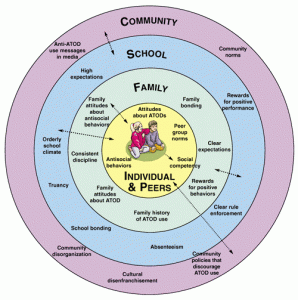
The next step is to have an ‘initial consultation’ – the first consultation to get the process going. Talking to the family provides essential information – any strengths or difficulties that the individual has will not be in a ‘vacuum’ – they will be embedded in the ecosystem around the child, teen or young person.
The focus of the initial consultation is to:
- Clarify the main reasons why educational psychology (EP) input is being sought at this time. This will clarify whether or not any expectations are realistic and potentially achievable.
- Explore the ‘hopes and aspirations’ that the parent/carer has for their child, teen or young person. This is a way of gathering information about the difficulties that ‘reframes’ it in a way that the potential for change is being cultivated. An important part of the consultation is to clarify the extent to which there is motivation and engagement in change.
- Determine the home situation, past and present. It is important to find out what the home context is like, including anything relevant that has happened in the past – and how this may or may not have contributed to the current situation.
- Start to gather information about any interventions or support in school that the individual is accessing. Sometimes the parent has information about this and it is very helpful if this is available. Information about what has been happening at home is also needed.
- Get information from other professionals – and permission to read their reports. This may include information from social care, medical professionals, school staff (individual education plans, school reports). If this information exists, it will contribute to the EP assessment process.
Following this, the process may simply end there – there may be sufficient information to make some recommendations. Time will be needed to implement these suggestions, this EP Advice. If no further EP input is needed at this stage, a “Summary of Consultation” notes will be provided. In the future, further consultation – known as consultation reviews – may be requested if needed to review and further develop the recommendations made.
It is also possible that during the initial consultation, the family want there to be an assessment. They also have up to a week to decide whether or not to go ahead with this – they may need time to reflect on the initial consultation and try out the initial recommendations that have been suggested.
If assessment is decided as the way forward, then no notes will be provided at this stage, instead, they will be included in the final report.
The aim of the process is for the EP to make recommendations about what to do. This can be used to create an ‘implementation plan’ about what to do.
If the school and family try out some of these recommendations they can find out what works or how they might do things differently to make things work.
In this way, through the involvement of the EP, and the recommendations, it is possible to determine how best to support the child/teenager/young person to make process in their learning.
Once this happens the ‘problem’ is solved and there is no more need for EP input.
 Holistic Education